

Should I repair my roof or replace it?
Repair when the damage is contained and the rest of the roof is still healthy: a handful of tabs, a split pipe boot, one flashing detail. Replace when the shingle itself has failed across the field, which shows up as brittle tabs that crack when lifted, granules collecting in the gutters, and bare patches. A twelve-year-old roof with one bad valley is a repair. An eight-year-old roof that has been through two hailstorms may not be.
Three tests that beat counting years
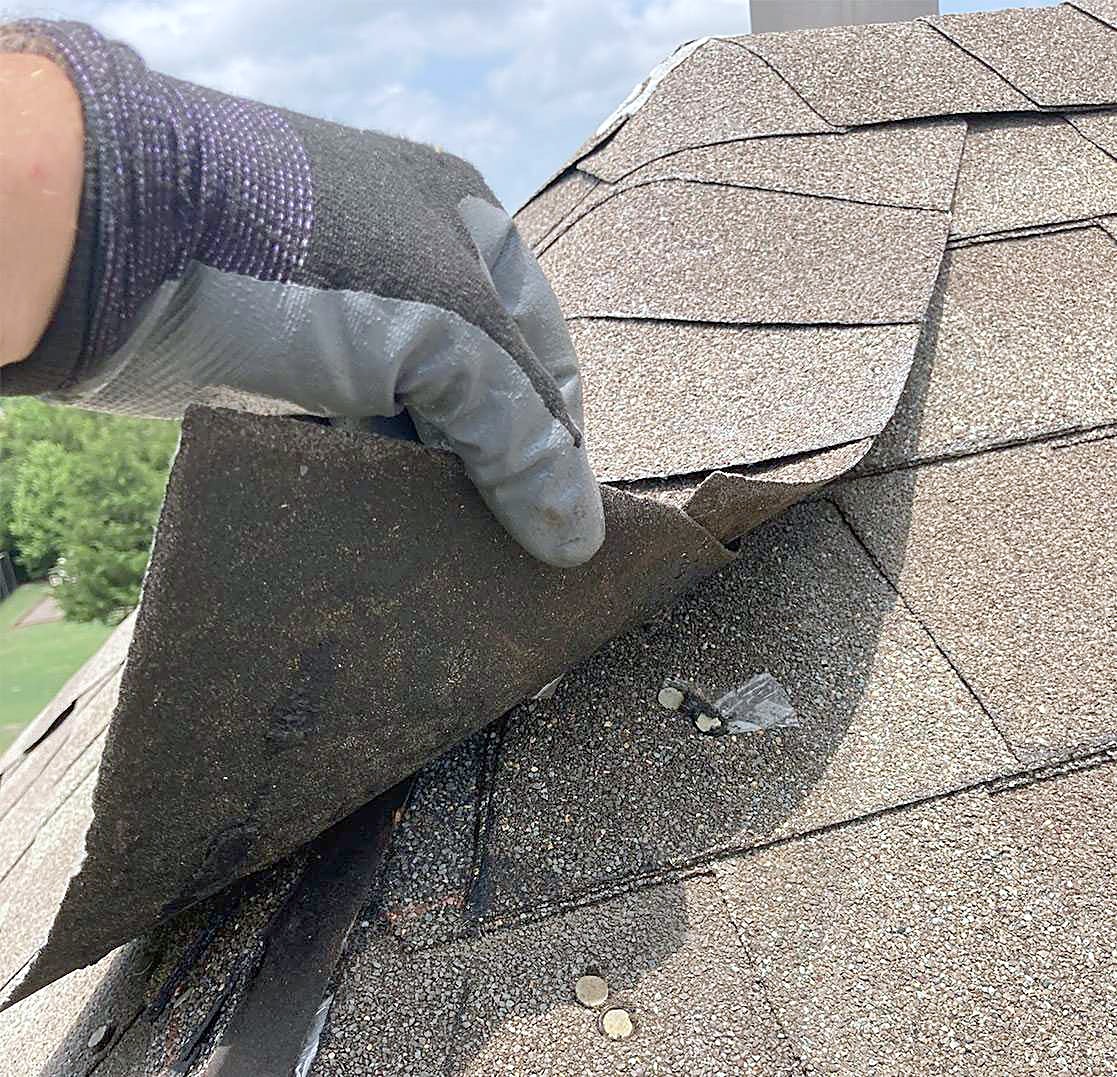
The flex test. Lift a tab on a warm afternoon and bend it gently. A shingle with life left gives. One at the end of its life cracks, and cracking means any repair in that area will damage the shingles around it going in.
The granule test. Look in the gutters and at the base of the downspouts. Heavy granule loss means the surface is going, and it goes everywhere at once because the whole roof got the same sun.
The area test. How much of the roof is affected, and is it in one place? Damage concentrated at one valley, one chimney or one slope is a repair problem. Damage scattered across every elevation is a roof problem, whatever caused it.
Why matching is often the deciding factor
Shingle lines get discontinued and colors get reformulated, so a repair on a roof more than about eight years old frequently cannot be matched exactly. On a rear slope nobody sees, that does not matter. On the front elevation of a house you are about to sell, it does.
Sun also fades a roof unevenly. A new shingle in the correct color still reads brighter than its neighbors for a year or two before it settles, which is worth knowing so it is not a surprise when the crew leaves.
When a repair is the wrong answer even though it is cheaper
Layered roofs. If there is already a second layer of shingle on the deck, a repair means cutting through two layers to reach the problem, and neither layer is warrantied any more. This is the case where tear-off wins on cost as well as on quality.
A roof at the end of its life with a leak in the field. Patching the visible entry point on a spent roof buys a season, and then the next leak is somewhere else. Two patches and a callout usually costs more than being told the truth once.
Structural or ventilation problems. If the decking is soft or the attic is unvented, the reroof is the only moment those become accessible. Fixing a leak over rotten decking is putting a plaster on the wrong thing.
And when replacement is the wrong answer
On a young roof with contained damage, replacement is money spent early for no extra life. A five-year-old roof with a failed pipe boot needs a pipe boot.
This is worth saying because the incentive runs the other way. A tear-off is a large invoice and a repair is a small one, which is why "you need a whole new roof" is the most common sentence on a free inspection, and why a company that quotes repairs as repairs is worth keeping the number of.
Related questions
How old is too old for a repair?
There is no fixed year. A well-ventilated roof at fifteen can take a repair; a badly ventilated one at ten sometimes cannot, because the shingle is already brittle. The flex test settles it in about ten seconds on the roof.
Can I repair one slope and leave the others?
Yes, and it is common after wind, which usually hits one elevation. Matching is the trade-off, and it matters more on a front elevation than a rear one.
Does a repair reset my warranty?
No. A manufacturer warranty runs from the original installation, and a repair does not extend it. A workmanship warranty on the repair itself covers the repair only.
Is an overlay ever a good idea?
Rarely. It hides the decking, adds weight, traps heat against the old layer and voids most shingle warranties. It is cheaper on the day and more expensive over the life of the roof.
