

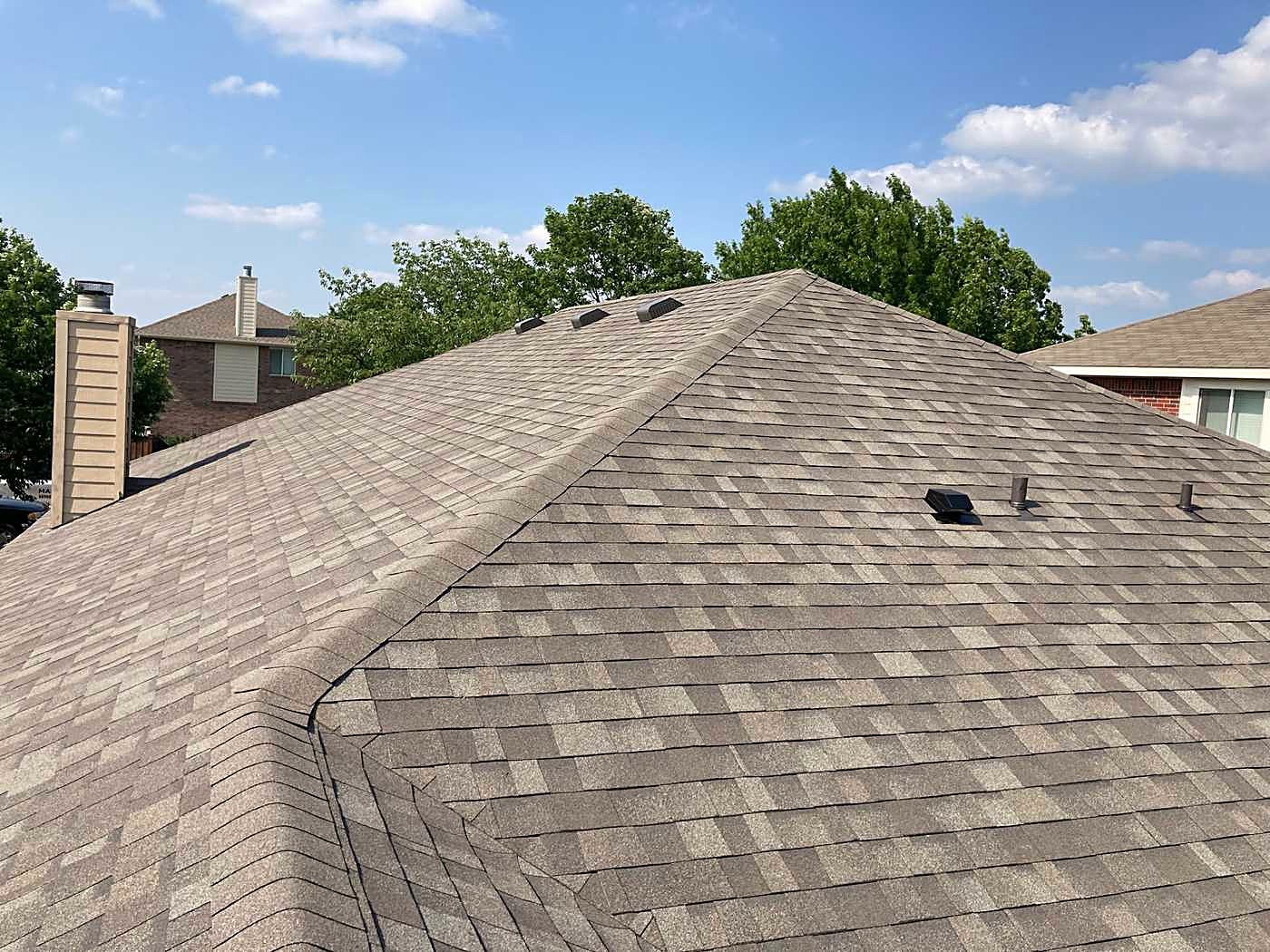
How long does a roof actually last in North Texas?
Roughly 12 to 15 years for a shingle sold as a 30-year, and 9 to 12 for one sold as a 25-year. The rating is a laboratory figure and North Texas is not a laboratory: deck temperatures over 150 degrees in August, 40-degree overnight swings in winter and hail most springs age asphalt on heat cycles rather than on calendars. Ventilation moves that number more than the brand of shingle does.
Asphalt ages on heat cycles, not on years
A shingle is asphalt holding granules onto a mat. Asphalt is a thermoplastic: it softens when it is hot and stiffens when it is cold, and every cycle drives a little more of the volatile oil out of it. Once enough of that oil is gone, the shingle is brittle, the granules stop sticking, and the mat cracks when it flexes.
North Texas puts a roof through more of those cycles, harder, than almost anywhere the rating was calculated for. A south-facing slope in Ellis County sees deck temperatures well over 150 degrees on an August afternoon and can drop 40 or 50 degrees overnight in February. That is why the same shingle that reaches 25 years in Oregon reaches 13 here.
It also ages unevenly. The south and west slopes take the sun, so they go first, which is why one elevation can be visibly worse than another on a roof that was all laid on the same day.
Ventilation is the variable you control
An attic that cannot breathe cooks the shingle from underneath at the same time the sun cooks it from above. Balanced ventilation means intake at the soffit roughly matching exhaust at the ridge, so air moves across the underside of the decking and takes the heat with it.
The most common fault on North Texas houses is ridge vent with no working intake, usually because blown insulation has covered the soffit baffles. The ridge then pulls its air out of the conditioned house rather than through the attic, which costs you on the power bill as well as on the roof.
The second most common is a bathroom fan discharging into the attic instead of through the roof. That puts warm, wet air against the decking every time somebody showers, and it shows up as damp sheathing and shortened shingle life years before anything drips.
A reroof is the cheapest moment ventilation will ever be fixable, because the decking is open and the vents are coming off anyway.
What actually extends it
Impact-rated shingle. Class 4 uses polymer-modified asphalt that stays flexible longer, which helps against hail and also against the heat cycling that makes hail damage worse.
Color, slightly. A lighter roof runs cooler than a dark one, and cooler asphalt ages slower. The effect is real and much smaller than the effect of ventilation.
Keeping debris out of the valleys. Anything that holds moisture against the shingle rots the mat from the top down, and on a north slope it grows moss that does the same job more slowly.
And catching the small failures. Pipe boots go at five to eight years here, well before the shingle does, and a split boot puts water into the deck around it for months before anybody sees a stain.
Related questions
Does a 50-year shingle last 50 years here?
No. The premium and designer lines do last meaningfully longer than a basic three-tab, but the ratings are all laboratory numbers and the North Texas discount applies to all of them.
My roof is 18 and looks fine. Do I need to replace it?
Not because of the number. Have someone flex a tab and look in the gutters. If the shingle is still pliable and the granules are still on it, it has life left.
Does a metal roof change this?
Substantially. Metal does not age on heat cycles the way asphalt does, and a properly flashed standing seam roof is generally the last roof the house needs.
Will insurance replace a roof that just wore out?
No. Policies cover sudden loss from a covered peril. Age and wear are excluded, and no inspection converts one into the other.
