

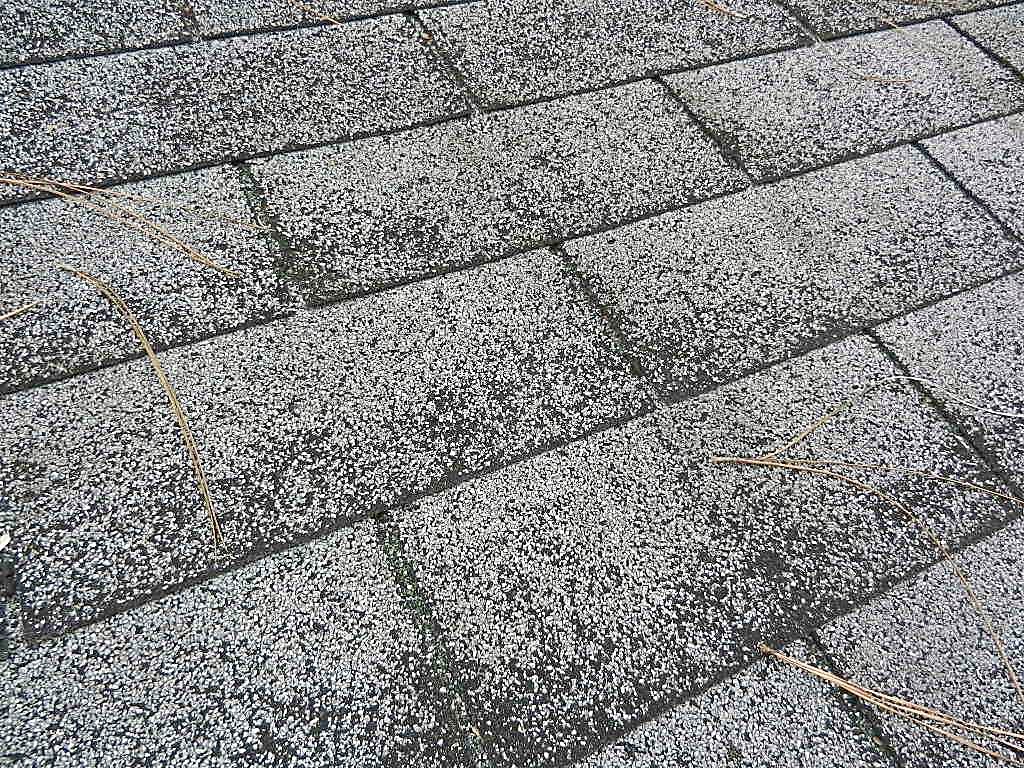
What does hail damage on a roof actually look like?
Mostly like nothing, from the ground. A hailstone bruises the fiberglass mat under the shingle and knocks the granules off where it lands, which reads as a dark circular spot the size of a coin rather than a hole. The reliable ground-level clues are dents in soft metals (gutter aprons, vent caps, window screens, the fins on the outside air-conditioning unit) and granules collecting in the gutters and at the bottom of the downspouts, because those dent and wash at a smaller stone size than a shingle bruises at.
The damage is a bruise, and a bruise takes two summers to become a leak
A shingle is a fiberglass mat coated in asphalt with granules pressed into the surface. The granules are the sunscreen. When hail hits, the impact fractures the mat underneath and shakes the granules loose at that spot, and now there is a coin-sized patch of asphalt with no UV protection over a mat that has already been cracked.
Nothing happens that afternoon. Over the following two summers the exposed asphalt oxidizes, the fracture opens, and the shingle fails from that point outwards. This is why a roof can pass a glance from the driveway in April and be leaking by the following August, and why the claim window matters more than how the roof looks today.
A functional hail hit is a hit that will shorten the life of the roof. A cosmetic one is a mark that will not. The difference is whether the mat fractured, which is why it is judged by hand on the roof rather than from a photograph.
The soft metals tell you before the shingles do
Aluminum dents at a smaller stone size than a shingle bruises at, which makes the soft metal on a house a free hail gauge. Walk the perimeter and look at the gutter apron, the downspouts, the roof vents and turbine caps, the window screens and, most reliably of all, the fins on the outside air-conditioning unit. Dents there mean stones of a size that will have marked the roof.
Then look at the ground. Granule wash collects at the base of each downspout and in the splash blocks, and a heavy layer of it after a storm is the roof shedding its surface. A small amount after a brand new roof is normal manufacturing loss; a fresh pile on a seven-year-old roof is not.
Also worth checking: a wooden deck rail, a painted fence cap, or a car parked on the drive. Spatter marks on those establish the storm hit this address, which is not the same as the storm hitting the ZIP code.
Wind damage is claimed less often and is easier to miss
Every shingle is held down by a strip of factory sealant that bonds it to the one below. A gust does not have to remove a shingle to ruin it. It can break that seal and lay the tab back down looking perfectly normal, and from then on that shingle is a flap waiting for the next storm.
The visible signs are a horizontal crease across the tab where it folded back, a line of tabs standing slightly proud along one rake or one slope, and exposed nail heads where a tab has shifted. Insurers cover wind. Almost nobody claims it, because almost nobody can see it.
What proves it is a test square
An adjuster does not walk the whole roof counting. They mark a ten-foot by ten-foot square on each slope, count the functional hits inside it, and scale from there. Enough hits per square and the slope is called; below the threshold it is not. Thresholds vary by carrier, which is exactly why the counting has to be done carefully rather than argued about afterwards.
This is also why the contractor being on the roof with the adjuster matters. A square marked on the least-hit part of a slope and a square marked in a representative spot produce different answers about the same roof.
Related questions
How big does hail have to be to damage a roof?
One inch is the usual rule of thumb on asphalt, but it depends on the age of the shingle, the wind speed behind the stone and the pitch of the slope. A brittle fifteen-year-old roof marks at a smaller size than a new one.
Can I check for hail damage myself?
From the ground, yes, and you should. Soft metals, granule wash and spatter marks tell you whether it is worth having someone look. Getting on the roof yourself is how people fall off roofs.
Does hail damage always mean a full replacement?
No. Scattered hits on one slope can be a repair. A count over the threshold across the field usually means the slope, and often the roof, because matching a discontinued shingle across a whole elevation rarely works.
How long after the storm can I file?
Most Texas policies set a limit from the date of loss, commonly one year. Check your own policy, because the bruise that causes the leak will not show up inside that window.
